To begin with I believe that postmodernism suggests that the reality we are exposed to are always preceded by models and depictions; implicitly meaning that all of our experiences of reality are either a simulation or a simulacra. Additionally, postmodernism has no further meaning behind the representation; all of reality is a mediated simulation.
Postmodernism allows us to experience our lives as a perpetual present because we are always working towards something, whether it financially saving or envisioning an idealistic future in the year 2019.
Postmodernism is a theory consisting of five elements; its approach to culture through critiquing metanarratives such as Marxism and psychoanalysis; its focus on cultural representations across media; its attentive towards new media drawing out the complications of our experiences in reality; it challenges traditional conceptions of identity and subjectivity (particular how human identity ties with self consciousness), and its emphasis of pluralism in terms of race, gender, sexuality and class.
The postmodern critique of narratives, personally I believe to be problematic because it limits the audiences ability to consider political questions in historical context: there is a tendency to ask questions concerning space instead of questions concerning time and teleology. By emphasising space over time, Postmodernism eschews concerns with essence and depth and would rather focus on surface appearances. Through postmodernism critiquing the media; its theory suggests that our experiences of reality are always preceded by representations which heavily implies that all of our experiences are either a simulation or simulacra. For postmodernism there is no deeper reality behind the representation; all is a mediated simulation.

Focusing on issues with representation, postmodernism cultural texts often comprise references to the past which are filled with stereotypes of past styles. All these references are to a simulated past, this is why mainly characters from history are in heavy debate when it comes to postmodernism about references to these characters being ironic or if it’s just depoliticisation of the past.
Postmodernism is drawn out by converging cultures and commodifications. Postmodernism disavows the commodity-class dynamic of capitalism, meaning it can be supportive of other classes however, it can also be seen as underserving audiences by ignoring the underlying class politics of capitalist society.
Fordism espoused the theory of paying workers enough in wages so that they are able to buy the products they helped produce. Essentially, workers are now becoming consumers. By paying workers enough to do this quality of life is not only improved for the customer but it avoids the crisis of overproduction. Fordism and post-fordism are terms that reflect the political economy in the post-ww2 period. Post-fordism signalled a transition away from the welfare state and towards contemporary neoliberalism.
A majority of postmodernist theorists suggest that the shift away from industrial production to a more technology driven economy (postindustrial society) has shown that technology and knowledge are the underlying forces of change; rather than struggles of social class between capital and labour. In addition, the term postindustrial does not mean industrial production has deceased but instead means that industrial production has advanced to the developing world where labour is cheaper and regulations are less strict.
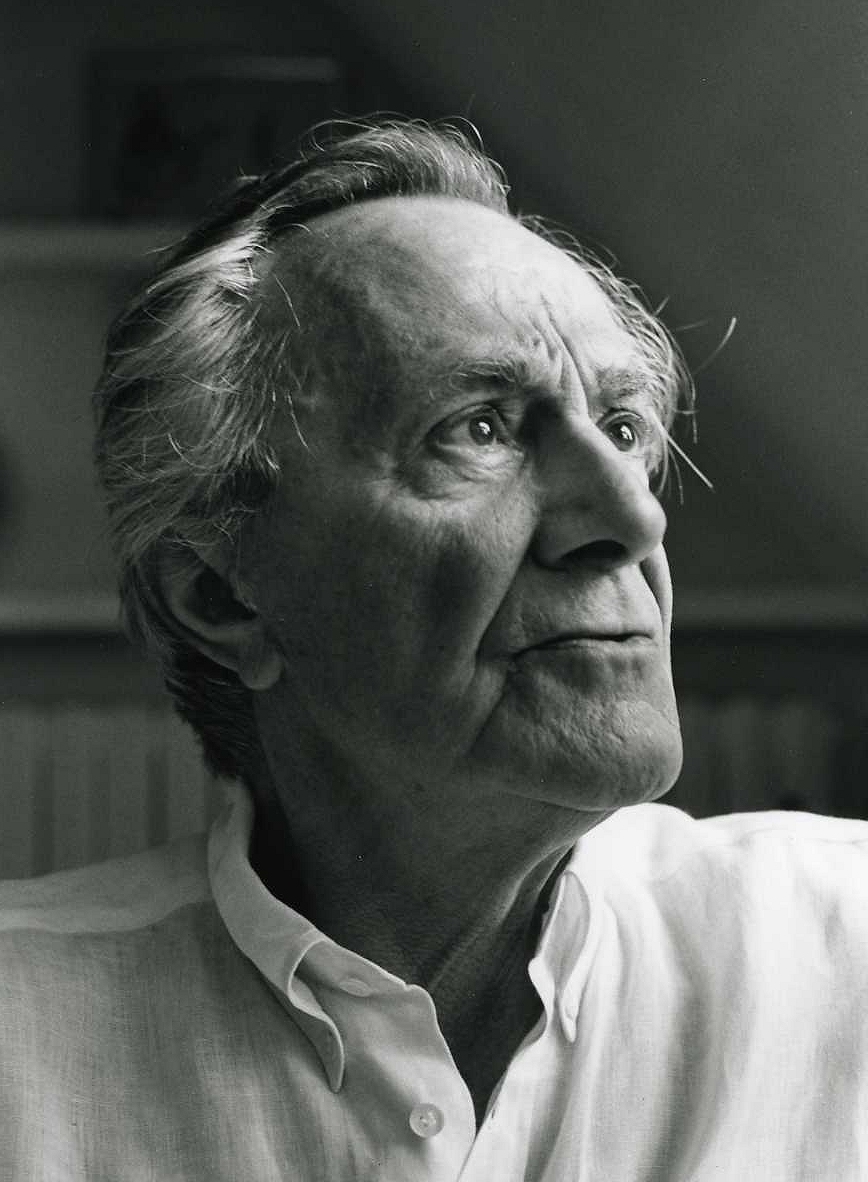
Francois Lyotard wrote in his book ‘The Postmodernism Condition’ (1979) that technology is the driving force of history rather than class struggle. Lyotard argued that metanarratives of history like historical materialism is no longer valid. According to Lyotard, grand narrative has lost its credibility due to postwar changes in technology and there is a rise in neoliberal capitalism with the reducing threat of a communist alternative. Lyotard defines postmodernism as: ” incredulity towards metanarratives.”
“History is hysterical; and is only constituted if we consider it, only if we look at it- and in order to look at it we must be excluded from it.” That is history for roland Barthes and the replicants who are perfect duplicate of a human. Replicants can talk and feel emotion the only thing they are deprived of is a history, for that they must be killed. The replicants are bioengineered androids, however the Nexus 6 is identical to humans but their lifespan only lasts four years to avoid the replicant becoming fully self aware of its emotions. identification of replicants was known by answering questions in the Voight-Kampff test, the only two people this hasn’t worked for is Racheal – her true identity could not be deciphered with the test and is proved to have a lifespan over four years – and Deckard who avoided talking about if has participated in the test or not with every opportunity that arose.
I believe Blade Runner is a metaphor of the postmodern condition. Theorist Jameson suggests that the postmodern condition is characterised by schizophrenic temporality and a spatial pastiche. Schizophrenia is basically the breakdown of the relationship between signifiers linked to failure of access to the symbolic. With pastiche there are boundaries and a process of erosion of distinctions. Pastiche is intended as an aesthetic of quotations pushed to their boundaries; it is an imitation of styles deprived of any satirical impulse.
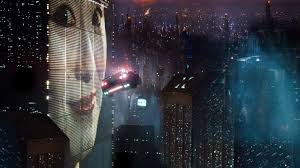
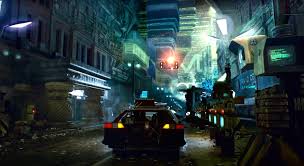
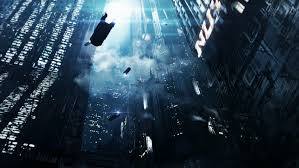
The line between postmodernism and late capitalism highlighted further in the films representation of postindustrial decay. The city in Blade Runner is not modern but postmodern with an orderly layout if buildings with hypermechanized interiors. This creates an aesthetic of decay and the dark side of technology.
Moreover, replicants are the perfect simulacra – a convergence of genetics enacting the dimension of simulation. Baudrillard describes the simulacrum as “an operational double, a metastable, programmatic, perfect descriptive machine which provides all the signs of real and short circuits all its vicissitudes.” i feel this is the perfect definition to give towards the replicants and their capacity of simulation in the narrative motivation of Blade Runner. In 2019, L.A, simulation is completely dominant as the effect of existence and operations of the replicants; “it is that of hallucinatory resemblance of the real within itself.”
Racheal manages to reach the perfect simulation of a human, which indicates that she is internalising the signs and symptoms to the point where there is a blurred line between true and false. The system has achieved perfection with Racheal and it is noted that she is the perfect replicant because she doesn’t know if she is real or not – to say that she simulates her symptoms is to say she realises this and goes to experience them. Ultimately, the replicants are superior to humans but they have the problem of a fragmented temporality – schizophrenic vertigo.

The mystery to if Deckard is a replicant will always remain unanswered even under the heavy implications that he is when Edward follows deckard around leaving a trail of origami signifying he knows whats always going on inside his brain. However, I personally believe given on the information we were provided with Racheal I have the theory that Deckard is also a replicant with no expiration date and their love for each other was already written for them.

Web.stanford.edu. (2020). bladerunner.rtf. [online] Available at: https://web.stanford.edu/dept/HPS/Bruno/bladerunner.html [Accessed 20 Jan. 2020].
MaricelaJJBB (2020). “Lyotard and Postmodernism” Key Terms and Ideas. [online] Slideshare.net. Available at: https://www.slideshare.net/MaricelaJJBB/facilitation-on-issuu [Accessed 20 Jan. 2020].
raybloggs (2020). Postmodernism theories and texts. [online] Slideshare.net. Available at: https://www.slideshare.net/raybloggs/postmodernism-theories-and-texts [Accessed 20 Jan. 2020].
Esquire. (2020). Will ‘Blade Runner 2049’ Solve the Most Heated Debate in Sci-Fi?. [online] Available at: https://www.esquire.com/entertainment/movies/news/a55943/harrison-ford-blade-runner-2049-rick-deckard-replicant/ [Accessed 27 Jan. 2020].
 Victoria's Movie Mania